

What Makes Destinations Commercially Successful? The New Drivers Of Investment Value
.png)
A destination that only works on opening day has a shelf life. The mix of hospitality, retail and leisure that looks right at launch won't look right five years on, because the guests, the operators and the market around it keep moving.
Most investment models still treat opening day as the finish line. It isn't. A destination's real commercial
performance plays out over the years that follow, as guest habits shift, operators change hands, and travel
patterns move in directions nobody priced in at sign-off.
Bob Hamersma, Managing Partner at Forsite, puts it simply:
"The destinations that succeed are the ones designed to evolve, rather than perfectly planned for one moment intime."
It's a simple line, but it holds up at every scale of a project, from the masterplan down to a single restaurant floor.| Worth walking through why.
Leave room for identity
Every masterplan is a bet on how people will behave, and most of those bets don't fully land. Consumer habits shift faster than construction timelines. The uses that end up mattering most are usually the ones nobody budgeted for.
The developers who understand this stop trying to get the plan perfectly right and build room for it to be wrong instead. Phasing rather than finishing everything at once. Plots that flex. Temporary uses that test what works before anyone commits capital to what should be permanent.
Mina Zayed in Abu Dhabi is a good example. 421 Arts Campus, once Warehouse421, is now a proper cultural platform: converted industrial warehouses turned into galleries, studios, a café and community space. The site became a destination because the people using it were given room to shape it.
"Places become destinations partly because people are given room to appropriate them," is how Bob puts it.
That's a real counterpoint to the enormous, fully scripted masterplans getting approved across the region right now. The same logic runs through adaptive reuse everywhere, from Al Quoz to waterfront and warehouse regenerations in nearly every major market.
Flexibility is an investment case, not a design preference
Once that logic holds at the destination level, it holds harder still at the level of a single asset, and the commercial case writes itself.
Take the Santiago Bernabéu. The pitch retracts and stores underground. The roof and floor reconfigure so the stadium hosts concerts, conventions, fairs and other sporting events on top of football. Real Madrid markets the venue for year-round use because it was engineered to work that way from the start, not retrofitted after the fact.
"If an expensive piece of real estate can perform 200 days a year instead of 30, its value proposition
fundamentally changes," Bob says.
That's the moment design stops being a placemaking conversation and becomes a capital efficiency one.
Seasons demand different assets
Nowhere is this more literal than in seasonal hospitality, where demand doesn't fluctuate so much as change character completely. High season, shoulder season and low season bring different guests wanting different things. An asset built for only one season sits idle for the rest of the year, and that's not bad luck, that's the design.
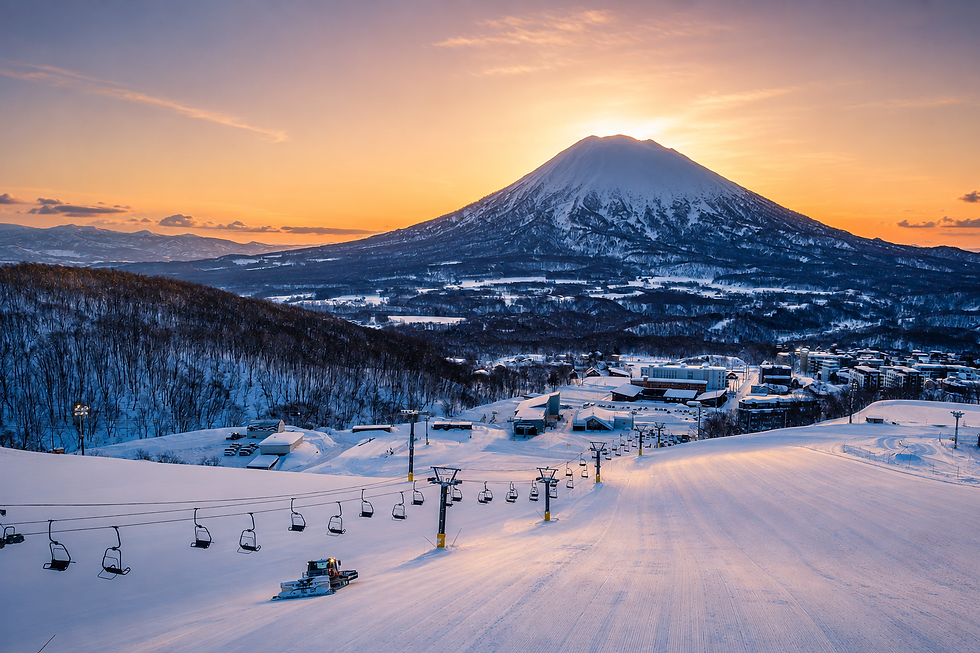
Niseko in Japan is the clearest version of this. It's a ski town built around a four-month winter peak, and the operators who thrive there aren't the ones simply bolting summer activities on top once the snow melts. It's the properties designed from the outset to hold two different identities, something we're seeing first-hand on one of our current projects in the region: a restaurant that runs full service through ski season and resets into an events or wellness space through the warmer months, a kids' club that becomes a function room once family ski traffic disappears. Get that wrong and half the year underperforms, waiting for winter to come back around.
Porto Montenegro shows the same principle from the other direction. AURA Montenegro, delivered with Sunset Hospitality, is a poolside concept in a market that's essentially a summer destination. The venue had to be fully operational for peak season within months, while staying open to phases that hadn't been built yet. The answer wasn't overbuilding for a short window or locking the design down early. It was an operational strategy mapping how the site would grow, so each addition could integrate without disrupting what was already running.
That's the same principle behind good hospitality asset management anywhere, whether the market is a
Japanese ski town or a Montenegro marina.
Bob's version of this question is the one we ask on every project:
"The question isn't only what is this space, but increasingly how many commercially relevant roles can this space
perform."
Transformation as part of the experience
"Multi-use" can easily slide into conference-hotel thinking: beige, generic, apologetic. The best examples do the opposite, making the transformation part of the story.
The Fore at Jumeirah Marsa Al Arab opens as one breakfast destination and becomes four separate restaurants through the day: Umi Kei, Madame Li, Mirabelle, The Bombay Club, plus a central bar. This is a transformative dining destination by design.
The flexibility isn't hidden in the back of house — it's the headline. Bob sums up why that distinction matters:
"Flexibility doesn't have to mean compromise. Transformation itself can become part of the guest experience."
Forsite Creative shapes high-performing assets through hospitality and service-led design. To discuss a project, contact info@forsitecreative.com
Where value actually gets made
Destination, asset, season, concept: the same idea repeats at different scales. Long-term value comes from how well something can change after opening day, not how precisely it was programmed before it. That should change how developers, operators and investors size up an opportunity, and it means design, operations and commercial strategy belong at the same table much earlier than usual.
As Bob puts it:
"What defines the next generation of high-performing destinations is how intelligently they're built to change after opening day, not how perfectly they're programmed on it."
Most of the value gets won or lost in the gap between concept and operation. That's why the decisions that matter need to happen before they're irreversible, not after.