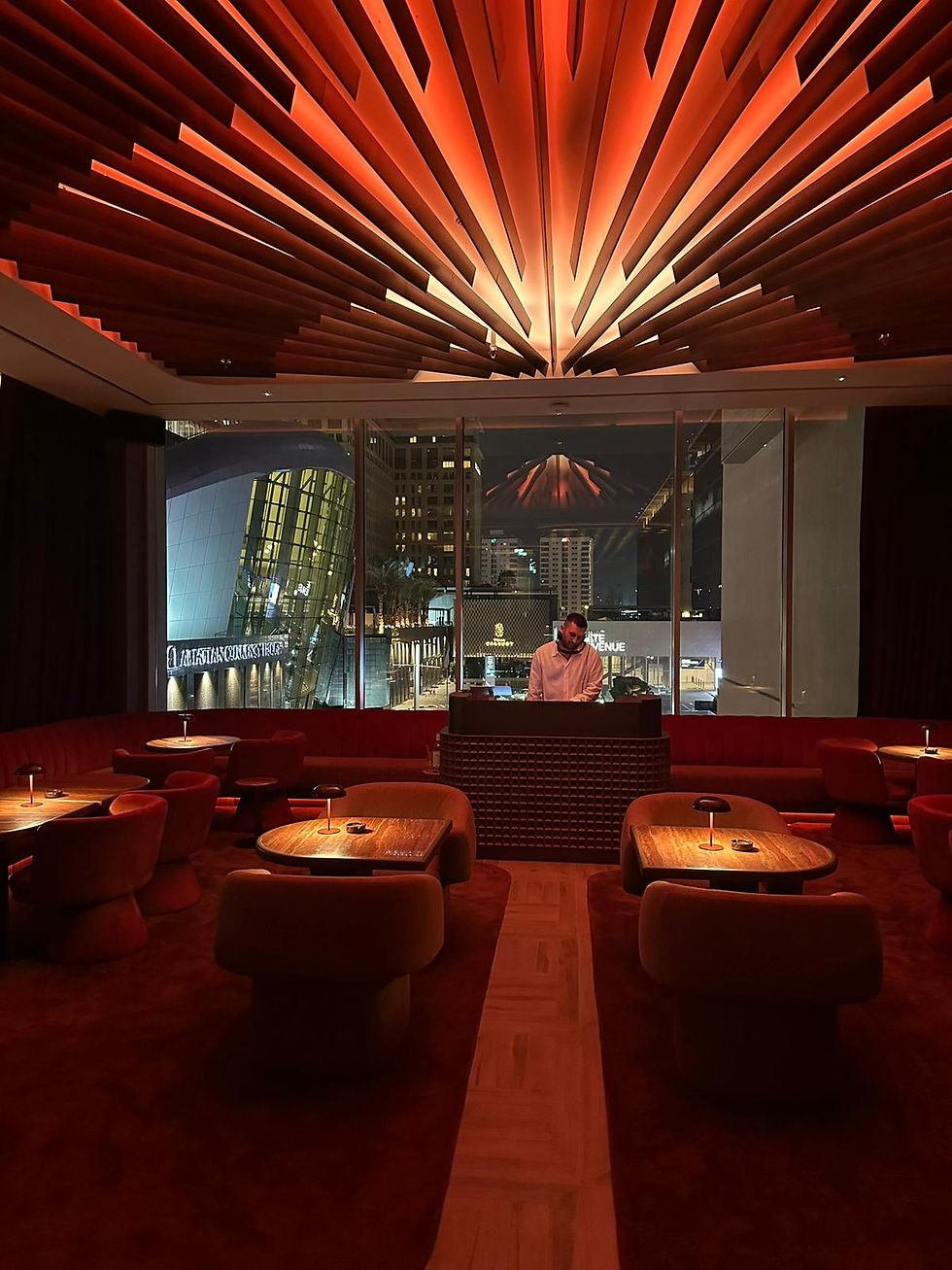
Kuuru
Client: Leylaty Group
Location: Riyadh, KSA
Date: March 2024
Cuisine: Nikkei
Add: ........
Kuuru is a Japanese Peruvian concept that embodies an elevated casual atmosphere and is truly unique to the Saudi Arabian market. Kuuru’s aesthetics and the F&B offering have formed a unique and dynamic causal Nikkei concept that blends both cultures innovatively.

Fairmont Makkah
Location
Makkah, KSA
Industry
Culture & Religious Districts
Client
Accor
A full-scale repositioning of F&B within one of the world’s largest hotel complexes, built to operate under extreme demand.
Located in Makkah, the Fairmont Royal Clock Tower serves a religious market with highly specific operational and cultural requirements. The scope covered F&B audit, strategy, concept development, branding, kitchen and BOH design, OS&E, uniforms, and design direction, reworking the entire F&B ecosystem to perform across radically different demand scenarios.

The challenge
An F&B operation required to function at both international hospitality standards and mass-serving pilgrimage scale.
From the client’s perspective, the complexity sat in reconciling two fundamentally different modes of operation. During Ramadan and Hajj, the property must deliver more than 15,000 meals per day, serving guests ranging from large pilgrim groups to VVIPs, across diverse nationalities and expectations.
Outside of these periods, the expectation shifts toward destination dining with a more conventional luxury positioning. The problem was how to create an F&B offer that could stretch between these extremes without breaking operationally or losing relevance in either context.


The APPROACH
Operating across multiple realities.
The work began with a full audit of the existing F&B landscape, followed by market research and the development of a new strategic framework. This was carried through into concept development, branding, and spatial planning, alongside full kitchen and BOH design.
Collaboration with LW ensured alignment across disciplines while maintaining control over F&B logic. The strategy introduced multiple operating models, à la carte, family-style, and buffet, designed to be deployed depending on season and demand.
Operational efficiency was addressed through revised service methods, integration of new technologies, and rethinking back-of-house flows to support high-volume output without compromising service standards. At the same time, each concept was positioned to meet international benchmarks, ensuring relevance beyond peak religious periods.

HOW DID WE STRATEGIZE A PLACE THAT WORKS?
Dual-performance F&B model
Each concept was designed to function as a destination restaurant under normal conditions, while being capable of scaling into high-volume service during peak religious seasons.
Operational flexibility as infrastructure
The strategy embedded multiple service formats and adaptive operating models, allowing the property to shift between à la carte, buffet, and group dining without reconfiguring the entire system.
Back-of-house driving front-of-house performance
Kitchen and BOH design were treated as central to the strategy, enabling the scale, speed, and consistency required to deliver up to 15,000 meals per day.

THE RESULT
The repositioned F&B framework aligns operational capacity with the realities of pilgrimage-driven demand while maintaining relevance as a year-round dining destination.
As Makkah continues to receive increasing volumes of visitors, the model is built to absorb that growth without requiring structural change.